
I thought I would take the time to share a few random thoughts about drying wood. I’ve learned a ton about what not to do from my own misguided efforts as well as heeding the sound wisdom of others. The combined total now yields consistent, high quality turning wood when it is dry. Perhaps the best way to present what I have learned is a simple list. It is in random order rather than by importance. When I can substantiate my thoughts I will do so, but in some cases, I can only assume that some facts are correct because I cannot prove them otherwise. The first point is an example of the latter.
General Considerations When Drying Wood
Air drying. Wood (it appears that all species are roughly the same) air dries roughly at a rate of one year per inch of thickness. I can only assume that probably changes depending on climate. Our Wet Coast climate would certainly impact that differently than the drier interior climate in British Columbia. Folks in drier climates have to actually work to slow the drying down to prevent cracking. “Air drying” is simply that – drying at ambient temperatures in open air – as opposed to wood placed in a dry kiln. The time generalization is true up to three inches of thickness. After that, the “rule” is no longer linear. My experience is that air drying probably comes to a practical end at about 5 or maybe 6 inches. I had some black walnut that was 4 inches thick that I know was dry after about 6 years and an 8” piece of maple burl that wasn’t dry after more than 30 years. I assume the linear rule also generally applies to kiln dried wood because I have never seen kiln dried wood thicker than 3”.
Wood in large cross section. Simply cutting tree rounds and splitting them in half (“bolts”, in logger-speak) is the best way to make firewood rather than turning stock. You can seal the ends all you want but it will crack eventually because the wood is unable to move as the water leaves the wood. In raw wood form in large cross section, movement can’t happen, so the stress imposed on the wood can only result in cracking to relieve that stress. An obvious example is the cracked ends you see on milled lumber even after sealing. When leaving wood in this form out of necessity (i.e. milled lumber) the only thing you can do is allow for some loss by cutting it longer than needed. That’s a practical approach when milling common lumber but not with turning wood. I have, on a couple of occasions, brought a full log home and cut what I needed as I needed it. I got some minor loss over time as I processed it from one end and significant loss on the other end, but it was just not practical to process the whole log at one time. Not everyone has the literal real estate to do that, however. Cutting “rounds” for future bowls is unsuccessful because just like a board, sealed or not, the wood cannot move and your 16” blanks will only yield a 10” bowl at most. The only successful way to cut rounds is from a previously dried board.
Flat stock. I have dried a lot of wood for spindle turning and smaller items such as lidded boxes or other smaller items, both utility and decorative. This is easily done by essentially cutting shorter “boards” from tree rounds that are generally cut for bowl stock. Of course, just like any “board”, some loss must be expected. These shorter lengths are more easily stored and handled than longer boards and at least makes use of wood that is otherwise lost while making bowl blanks.
Rough turning. The only sure way of minimizing waste when processing green wood for turning bowls is to rough turn the wood into bowl forms, sealing the end grain areas then racking the wood up in an outside area that is out of the rain and sun. This allows the wood to move as it dries and actually speeds up the process since water leaves the wood through the end grain and those ends are very close together, unlike a simple board where the ends are many feet apart. Of course, if you have the ability to “core” bowl blanks from a larger blank, this further enhances the efficient use of the wood.
Considerations when Preparing Rough Turned Bowl Blanks
Rough turning details. I was first taught that rough bowl blanks must have even wall thickness to allow even drying and thus, less cracking. That is absolutely not true! In fact, that is the best way to guarantee that the blank will crack near the bottom on the outside at what I call “the turn of the bilge”: basically, that area where the side becomes to bottom.

The rough turned blank will want to bend upwards at the ends or sides (depending on grain orientation) so it needs to be thin enough to bend in that area. After agonizing over all my losses, I finally found a video from Glenn Lucas explaining how he prepares a rough-turned bowl blank. Since he turns literally thousands of bowls every year, I feel he is a bit of an authority. These are now the guidelines I follow for a flat-grained bowl blank (not end grain):
a) Leave the bottom of the blank about ¾” thick not including the tenon. The rationale is that wood shrinks very little – if at all – across the flat grain so that leaves plenty of wood for the bottom wall thickness.
b) Allow 10% of the diameter of the blank wall thickness at the top of the bowl only but taper the wall thickness from that point to the ¾” bottom. It would seem counter intuitive to taper the wall but consider this; the actual diameter is reduced as the bowl approaches the bottom so if you use the 10% rule, that wall thickness will become progressively thinner as you approach the bottom. In practice, that thinner wall will allow the blank to move instead of cracking as it dries. Since I have used this guideline, I haven’t lost a single blank and have never not had enough wood to complete the bowl. (My English teachers are rolling in their graves over that double negative 😊). The act of rough turning lots of bowl blanks has an added advantage in that you get to practice your turning technique without the expectation of achieving a “dead on” form, thus taking the pressure off, allowing you to make lots of cuts that are “close, but no cigar”. I find the 10% rule seems to vary a bit by species and is a bit extreme for anything over about 14”, so you will have to learn the ideal dimensions as I did, through trial and error.
c) There should be no sharp edges on the top rim. This “rule” seems to be general knowledge, but not necessarily to everyone. A sharp edge will dry very quickly (even in the first hour) so tiny cracks will appear that are the seeds from which large cracks grow. The solution is to round those sharp edges over, preventing the rapid drying.
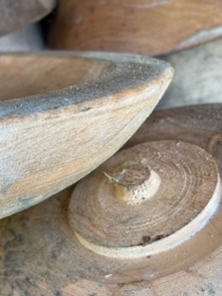
d) When processing log rounds, don’t get greedy by coming too close to the pith. The tighter the ring, the greater the stress. Err on the wider side when taking the center slab/pith out of the tree round, i.e. 3” in a 24” trunk. This can be a major source of particularly rim but even bottom cracks (depending on orientation) in a bowl blank.
e) A wax emulsion is generally accepted as the most practical way of sealing to prevent cracks. Paint, is not. Clear wax emulsion is best for our purposes – it does come in opaque colours – because it’s handy to see the grain for proper orientation for final turning. The point of “sealing” the wood is to allow a slower egress of the water from the wood, not stop it altogether. Slowing the drying process gives the wood a chance to move as it dries. I don’t know if paint seals or doesn’t seal the wood, but anyone I know that has used paint has not had any success. In any case, you can’t see the grain and it’s certainly not cheaper than actual end grain sealer.
Alternate Methods of Drying Wood
It is possible to slow the drying process in other ways, but they are labour intensive or only good in the short term. They are fine for a few but not for many. Using paper bags and swapping dry bags for damp bags works quite well. I have used that method successfully, but you need to monitor them daily. Burying a blank in its own shavings works really well for an overnight or couple day pause in turning but isn’t practical in the long term. Wrapping fresh-cut bowl rounds with shrink wrap works for a few days but promotes mould growth amazingly quickly. I can’t understand the logic, but I have heard of people swapping plastic bags in a similar way to using paper bags, but I can see that mould would be a constant issue due to the free water that stays on the wood’s surface.
Microwave drying is a valid option for individual small pieces. I have my own microwave. It’s a microwave designed specifically for woodturners. You can Google the source by searching “get your own damn microwave” 😊. My recommendation is to set it on “defrost” (definitely not “high”) then program it (if available) or time it for ten minutes on defrost and ten minutes rest (depending on power rating, of course). That setting can make it too hot to hold so it’s definitely hot enough and judging by the amount of moisture on the window during the rest period, more water is driven out in the rest period than when being heated. If you can’t program it, make sure you set a timer so that it doesn’t’ cool off too much during the rest period. Use a moisture meter or a weighing method to determine when it is “done”. The lack of moisture on the glass is a pretty good indicator as well. This is a method more suited to “turned to finish”, thinner pieces since it is going to move very quickly in a short space of time, so rough turned (read: thicker) pieces need not apply.
Using a large dry kiln is much easier than you might think and the result is similar to air dried wood since high temperatures are not used (normal kiln dried wood is terrible to turn compared to air dried) There are two types and I have both.
Making a Large Dry Kiln
Step 1: A classic is to get your hands on a dead fridge or upright freezer. It’s fairly critical that it has wire shelves to allow maximum air movement. Be mindful of the fact that the cooling medium is probably bad for the environment, so leaving the compressor intact is a viable option. Make a hole on each side of the body near the bottom (mine has 1 ½ holes) and one on the top (mine has a 2” hole) to allow for natural convection. Those dimensions were determined after much scientific experimentation (seriously kidding). It’s a good idea to cover them with coarse mesh to keep the mousies out. Mine has two light sockets inside and I use combinations of wattage and one or two incandescent bulbs at the bottom to achieve the heat I need, depending on time of year. Due to the fact that LED’s have replaced incandescents, probably the most practical replacement is ceramic heating elements that screw into light sockets (readily available on Amazon). I’m certain they are also safer.
Step 2: Using an internal thermometer to measure temperature, I start it off at about 75°F for a week or so then move it up to 95°F until the wood is dry. I use an electronic meter to measure the moisture content but weighing pieces and recording their weight until the weight doesn’t change is equally or possibly more accurate. It’s not unusual to have dry wood in 6 to 8 weeks.
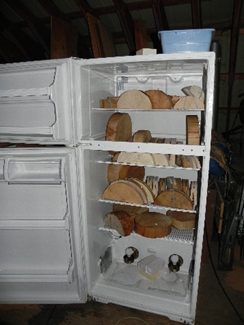
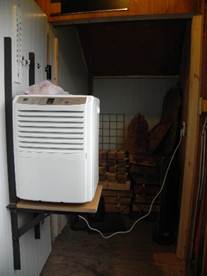
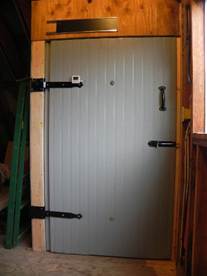
Step 3: Going a little more techy, plus spending a few more bucks will get you a kiln using a regular household dehumidifier. A fridge won’t work for this because the dehumidifier will take up most of the interior space. I suppose you could have one on the outside and connect it with ducting but that is probably tougher than building a larger, simple enclosure. I was fortunate to have composite freezer walls available, but a simple 2×4/plywood (preferably insulated) enclosure will work. Build it with racking that allows air flow and wire it so that a dehumidifier can be placed inside (or drill a hole for the cord). The machine itself generates a small amount of heat so that’s an advantage. You need to allow a way for the water to drain from the unit or be prepared to drain the receptacle (daily at the start). I start mine with a humidity setting as high as the unit allows then take it down gradually to as low as it goes. A slower pace is better than a faster pace. The time required is similar to the fridge/light bulb unit but has larger capacity. Photos below show kiln open and closed.
In Conclusion
As I noted in the beginning, I arrived at these conclusions after losing enough wood over the years for ten people, so definitely know what doesn’t work and what’s not practical. Because I’m a “country mouse” I enjoy the luxury of having a little more space than some folks, so having a full log at my disposal or processing wood at home isn’t an issue. Other than that, being a “city mouse” means that you will be preparing your wood in smaller quantities, but the information that I have shared is equally valid.
Also, because I’m a “country mouse”, one might think that I have access to all kinds of wood. Such is not the case because practically all of the wood standing or on the ground is on private property, so permission must be granted and/or beating the firewood savages to the punch becomes a significant barrier. “City mice” on the other hand, clearly have the upper hand on access to serious turning wood both in variety of species but also in prime physical access on public property – like, it’s on the ground at the side of the street – not a hundred yards through the brambles in the mushy bush. If you are in a highly urban area, you have access to smaller quantities more often, so harvesting smaller quantities of high-quality wood makes the sweat equity worthwhile. Remember: Chain saw = free wood. But also remember that owning and using a chainsaw brings its own responsibilities and safety considerations, neither being a big hill to climb.
So go out there and save that wood from the woodchipper. By taking a bit of care in processing, you will be able to turn all of it, not just half of it.
