
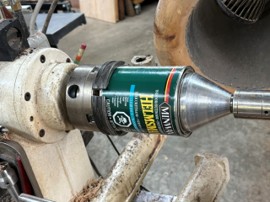
This all started a couple of months ago when Mike Moster messaged me about a slick way of mixing rattle can paints to avoid the seemingly endless and probably ineffective shaking prior to spraying. I think we’ve all given it the old college try then said to hell with it about 45 seconds into the effort. Mike sent a video of a PVC tube mounted on a hand drill that spun the can, mixing in no time flat.
Great idea! Gonna make one! Cue: procrastination. I already had the stuff I needed but it all sat on the shelf until I needed to use some rattle can lacquer, whereupon I kicked my butt for not assembling the goods. I was in a hurry, only needing to turn one part but thought, “Hey! Mount it in the lathe!” It seemed to work after I adjusted the speed so that I could hear the marble clunking in the can. A couple minutes while prepping the piece to be sprayed and I was in business.
Fast forward to yesterday when I needed to use some polyurethane that had sat on the shelf for at least three years. I was confident that it would be ok because I had put a finish on exactly one plane handle then put it on the shelf. At the time, the only issue was that it was supposed to be satin, but the plane handle shone like the sun, so clearly even when new, the solids that determines the level of the sheen had already settled in the can.
I opened the can and sure enough it looked new, but when I dug down with a little stir stick there was a layer of goo on the bottom that was as thick as tar. I tried dragging it back and forth to cut it into pieces and that sort of worked but clearly, I was getting nowhere. Light bulb moment! Rattle can!
I dropped a couple of ½” nuts in the can, sealed it up, mounted it in the lathe between centers, then adjusted the speed so I could hear the nuts clanking away in the can. Off to other chores for an hour or so then back for a quick check. I could hear sloshing instead of clanking so opened it up and…ta da! A stir stick across the bottom confirmed that the sludge layer was gone. Not only that, the mixture definitely had the hazy look of a satin finish. Those two nuts live in that can now.
I know that some of you may not have a chuck big enough to grab a one-liter paint can but there’s no problem turning a disk to fit of the bottom (or top) of the can jam chuck style. Even if you have a chuck that fits the can, I think the tailstock holding things in place is pretty good insurance against refinishing your lathe and whole shop interior. Not everyone will have a super-duper cone for their live center, but I know a piece of wood between the can and live center would do the trick. I used pretty much that set up for the rattle can mixer using a smaller chuck and a small block of wood against the plastic top.
I found that about 200 rpm did the trick in my case. A low speed like 200 rpm over an extended time could cause your motor or motor control to dangerously overheat. If you have a direct drive (i.e. Nova) that’s not a problem but if you have multiple ranges on your lathe (mine has three steps), I think it’s good idea to use the low range so that your motor will be going as fast as possible at the low output speed.
Using the jam chuck approach, I can see this working even for a 4-liter can, but I think a 20-liter pail is a bit of a stretch. But then…
