How I got here from there

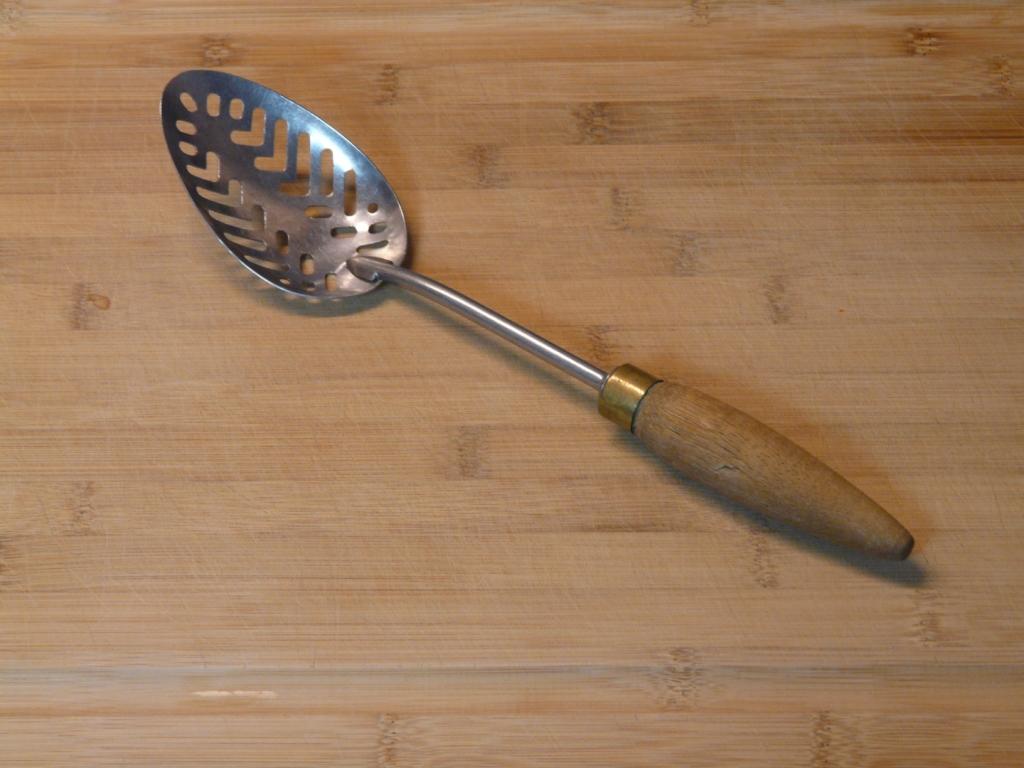
One of my very first turnings, circa 1958. Still going strong.

On my welcome page I commented that I got started as a turner when I was 9 years old. To some that might seem a bit improbable but you would have to know the environment in which I grew up. We lived in the country – some would say the bush 🙂 – and out of necessity had to be self-sufficient. Everything was approached with a “can-do” attitude so learning anything was taken in stride no matter how young we were. At any rate, my uncle showed up one day with a Beaver lathe and told me I could have it as long as I learned to turn. My father was an excellent turner so introduced me to the basic skills. There was no stopping me and I quickly cornered the market on file handles among my family and my father’s employees. The photo of the handle on the slotted spoon was one of my first turnings and was a request by my Mom to replace the broken plastic original.  

I remained interested in the craft but of course school and girls got in the way so I didn’t progress past file handles and the odd set of legs for stools. My basic skills were exactly that and when I left home for the big world, my visits home where for visiting, not learning more turning techniques. But I kept that lathe with me wherever I moved.  

Fast forward to the late ’80’s. I had begun to notice wonderful turned wooden bowls and other vessels in magazines and although I knew they were turned, I didn’t understand how they had been done. I yearned to learn, but there was nowhere to go to learn those techniques. One day when scanning the paper for lathes (my old one didn’t seem up to what I had in mind) I noticed an ad for Technatool lathes and the dealer promised to give little demonstrations for those that were interested: just show up. So I showed up. And several others showed up as well. We found that we had all been searching for the same knowledge and were all so pleased that we had found it. The dealer, Ian Waymark, was a woodwork teacher who had done an exchange in New Zealand and come back with the skills to not only turn wooden bowls but also the ideas behind some very interesting designs – like a wooden frying pan with two eggs all turned out of wood. I was totally hooked. The first and most important thing we all learned was how to cut instead of scrape. None of us have looked back since.  

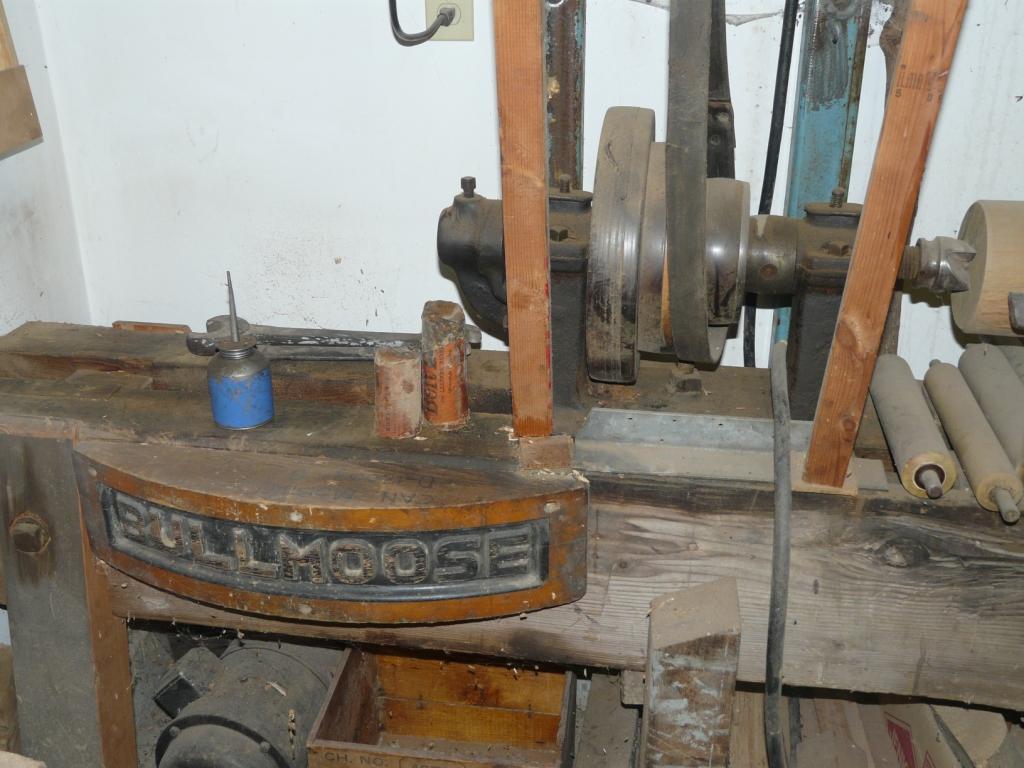
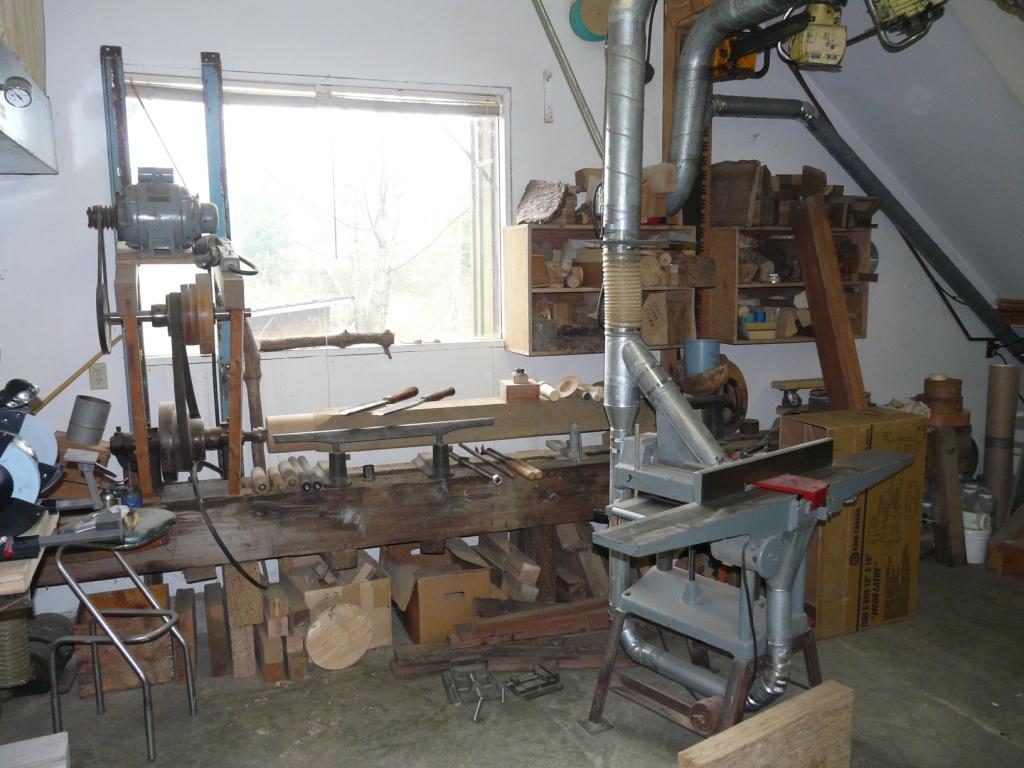
The Gray Ghost. It's a "Hutchings".

Originally a  group of prospective buyers of Ian’s lathes, we decided to morph into the Fraser Valley Woodturners Guild in 1988 so we could learn more. Naturally Ian encouraged us as that would generate a market, but he remained a good teacher and opened a world of woodturning to us that we never would have thought possible. I moved forward rather slowly but gained skill by turning a lot of architectural work for renovations that I did on the side (I was a firefighter in real life). I picked up a fabricated lathe made by a very interesting fellow, Bill Hutchings, who made it in his basement: the “Gray Ghost” in the photo. Looking back it was a terrible piece of machinery but it turned what I needed and I got pretty good, learning more and more as time went by.  

I went through what I like to call a “domestic restructuring” starting in 2000 so I was out of my home and shop for three years. Upon my return, I was back with my now wife, Arlene, and a whole new take on life. She encouraged me to pursue the craft and accompanied me to guild meetings so we could be together and at the same time not miss meetings. She encouraged me to join the Greater Vancouver Woodturners Guild since it was a more progressive group and more knowledge was available. This exposed me to world class turners in the flesh several times a year. My interest grew even more and my hunger for knowledge couldn’t be satisfied.  

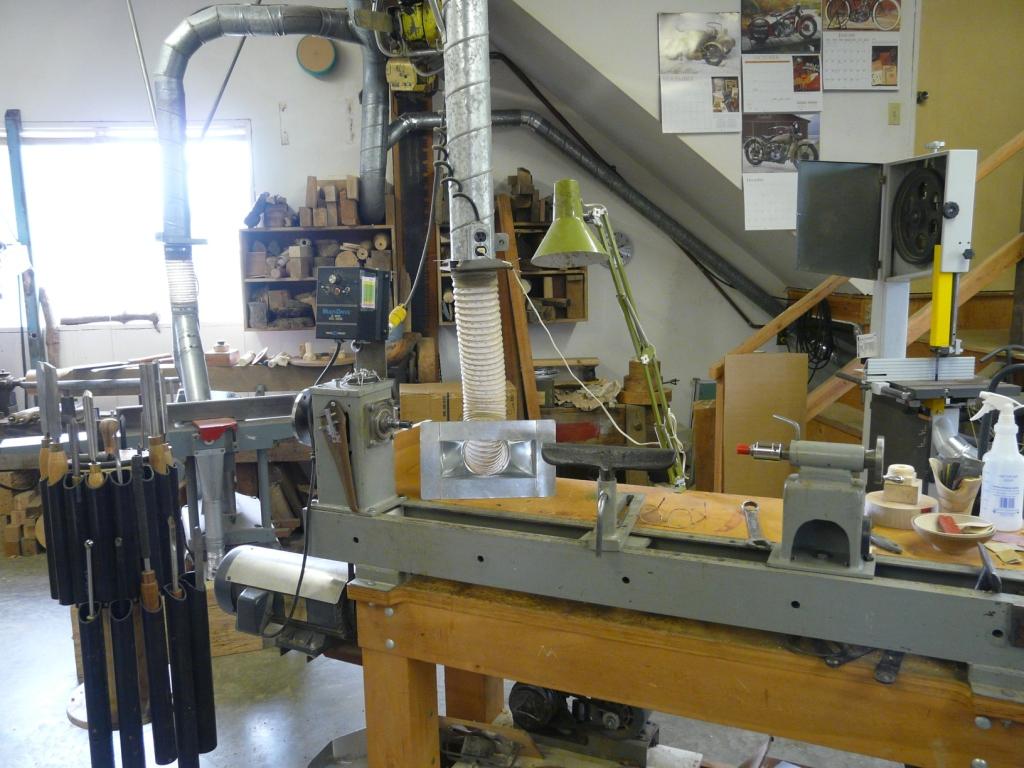
Upon retiring from the fire department I established a few goals for myself. One was to get my work into a gallery and I was successful on my first try. I was very pleased with myself and said to Arlene that I was proud of the fact that I could produce gallery quality work on the piece-of-crap lathe that I owned. Her response was “What could you do if you had a good lathe?”. To make a long story short I got my Oneway lathe for my 60th birthday and I haven’t looked back. Being in a gallery inspired me and motivated me to push my boundaries further than I thought possible. I had been playing with dyes for some time but now I was consumed by the use of colour in everything that I did. No longer could I bear to turn something “round and brown”. I had found my niche. Unfortunately the first gallery had to close but my work was quickly accepted by two others.  

My Oneway. The "blond" in the shop.

I refer to the work that I produce as “our” turnings – meaning mine and Arlene’s – and I am dead serious. I do the actual turning but I am constantly bouncing ideas off her and she responds with excellent input, valuable in it’s insight, un-influenced by woodturning convention. Most importantly, she has been my inspiration, always having confidence in my work and participating fully in what I do. She encouraged me to buy a lathe that I thought was far too extravagant, she has never once gotten angry when I drag shavings into the house and she never denies me the time to turn – as long as when she says “That’s not leaving the house”, the piece stays in the house, never darkening the  threshold of a gallery. I couldn’t refuse her.  She is my muse.  

I continue to push my boundaries and enjoy helping others learn what I have learned. This blog is part of that, so my hope is that others will contribute what they have learned along the way.

As always, I encourage your comments and questions, so please refer to the tag line at the bottom of the article to post a comment.
Posted in General, Welcome | Tagged | Comments Off on How I got here from there

Dust collector trick

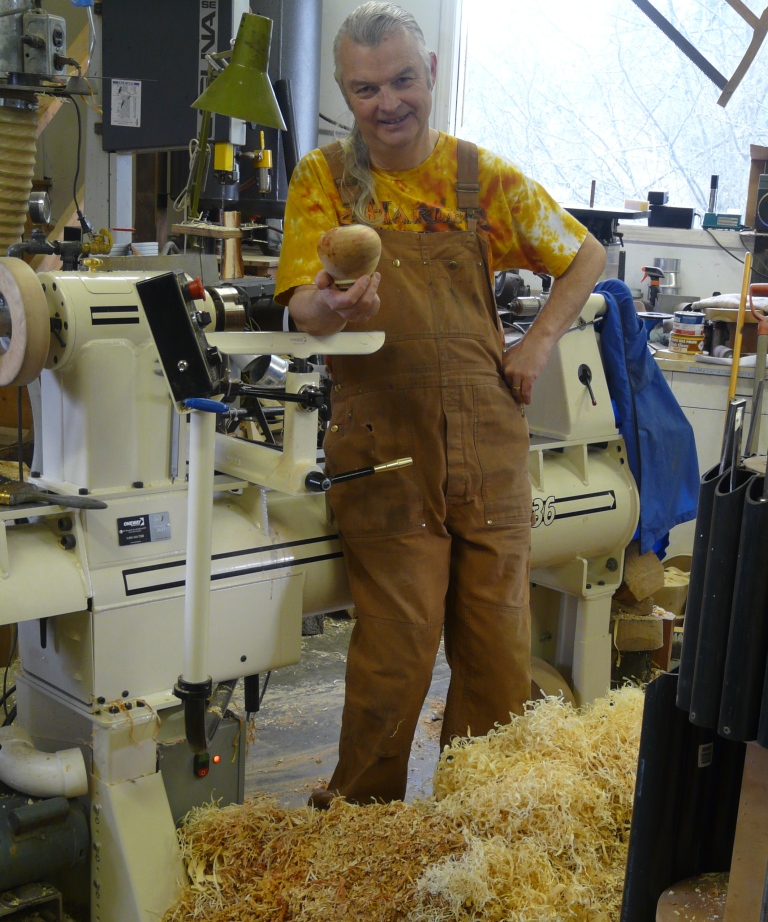
In the picture in the previous post about cup centers you will note that the dust collector pick-up has a shroud or frame around the opening. When I upgraded from my dust distributor system to an actual dust collector system I purchased “Woodshop Dust Control” by Sandor Nagyszalanczy (yup, that’s spelled correctly) as a guide. In the book Sandor recommends surrounding any free openings (as opposed to a fixed pick-up as found on, say, a planer) with a frame to increase efficiency. The frame reduces the amount of air being drawn from behind the boot therefore increasing the amount drawn from the front – where you want it. This works exceptionally well; so much so that I am going to increase it from the recommended 2″ minimum to 3″ to see what happens. At times it gets in the way but moving it out of the way has never put it out of range.

If your dust pick up is simply an open ended duct, your collector is not being used anywhere near it’s capacity. The heating boot – which can be horizontal or vertical – probably doubles the volume of a simple duct opening (you can also go too big) and the frame doubles that. I highly recommend Sandor’s book which is available on line through Lee Valley Tools. My guess is that about 99% of the home-shop dust collectors out there are under-used due to undersized ducting (probably 4″ PVC, right?).  Units around 1000 – 1200 cfm (2-3 hp) will require 6″ horizontals with 5″ verticles. Elbows should be long radius (2-45’s will do) and tee’s should be 45/wye combinations. I took the time to build a cyclone to make it a two-stage system; it works so well that hardly any fines reach the filter. Rebuilding my system was the best thing I ever did. The time spent has been paid back many times in reduced clean up time, my shop is a much safer environment and it’s just a lot nicer to work there.

As always, I encourage your comments and questions, so please refer to the tag line at the bottom of the article to post a comment.
Posted in Lathe Safety, Woodturning Tech Talk | Tagged , , | Comments Off on Dust collector trick

Using a cup-center drive

Recently I had the opportunity to participate in a workshop led by Mark Sfirri. Mark is well known for his  multi centered turning resulting in some very unique shapes. Probably the most well known are his “Rejects from the Bat Factory” series. We turned everything between centers and because the centers were off-set, the workpieces initially wobbled wildly on the lathe, meaning we turned a lot of air until a fair bit of material was removed. Because of all the interrupted cutting that we would be doing, the possibility of a catch was inevitable. As for all demonstrators, safety is paramount, so Mark insisted that we all use cup-center drives when turning.             

The use of  a cup-center drive was originally pioneered by Del Stubbs who found it to be an adequate but much safer drive than the typical spur drive.  The friction drive provided by a cup center provided adequate driving force without the disastrous results caused by the spur drive’s more positive connection  during a catch. 

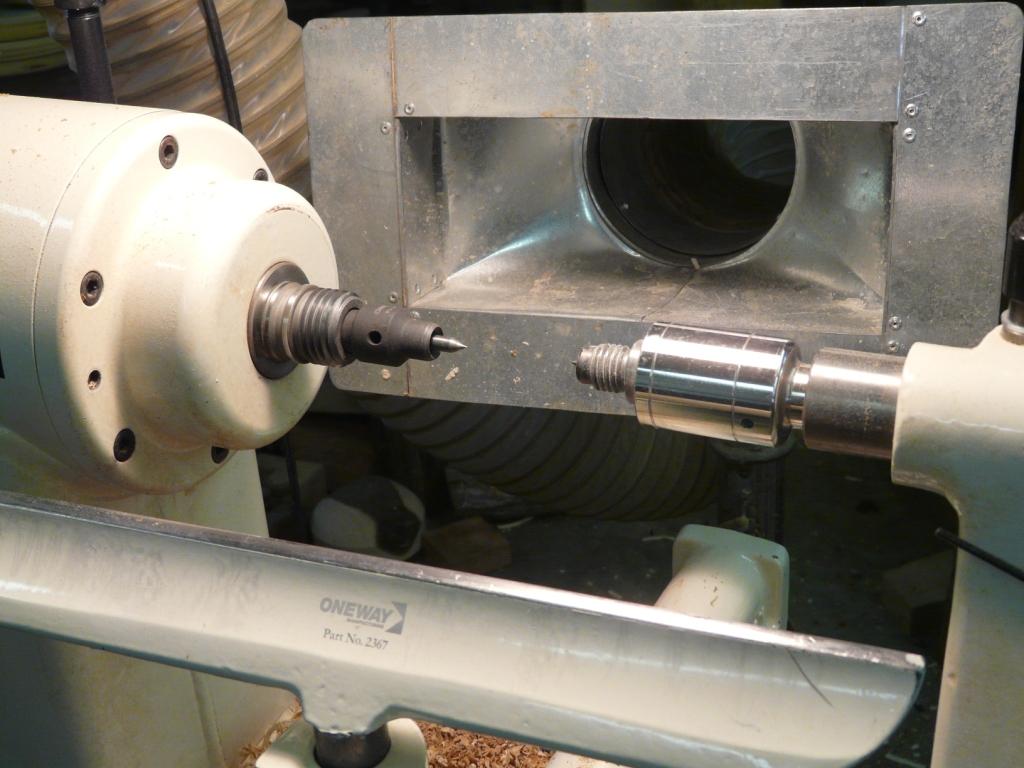
A cup-center drive is identical to the cup center used in a tail stock, ideally with a spring loaded center point, which is most helpful when turning multiple pieces (allows quick mounting and removal). You will notice the center point of the drive center is quite long. Because it is spring loaded it retracts into the center as the tail stock is tightened so the drive ring is then able to bear fully on the piece. A workpiece is mounted exactly as if using a spur drive, perhaps with a bit more end pressure than normal. As long as proper cutting practices are used, there is sufficient holding power to drive the work. If there is a catch, the work simply stops turning, then it’s a simple matter to re-tighten the tail stock quil and continue turning.  This is unlike a catch when using a spur drive where the wood continues to turn, increasing the drama with each revolution. There is a second major advantage that I can see: one tends to use proper cutting technique at all times.

A cup center was originally  supplied with my Oneway 2436  but I was skeptical that this would provide sufficient driving power: it ended up in my jungle drawer. During Mark’s workshop I found that it did, in fact, have sufficient driving power and I quickly became addicted to it. I  get very few catches but it is certainly nice to eliminate the excitement when one occurs. My cup-center drive now resides in my drive-center tray and gets used most often.

As always, I encourage your comments and questions, so please refer to the tag line at the bottom of the article to post a comment.
Posted in Lathe Safety, Lathes and Tools, Woodturning Tech Talk | Tagged , , , , | Comments Off on Using a cup-center drive

Mind and Matter Art Festival

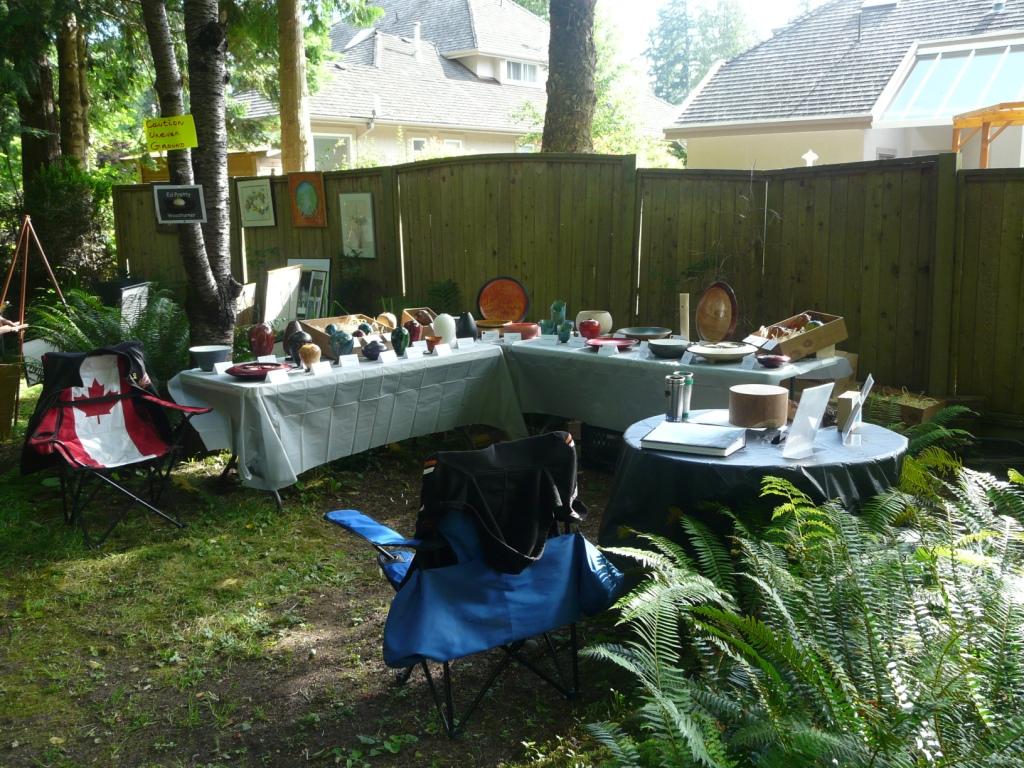
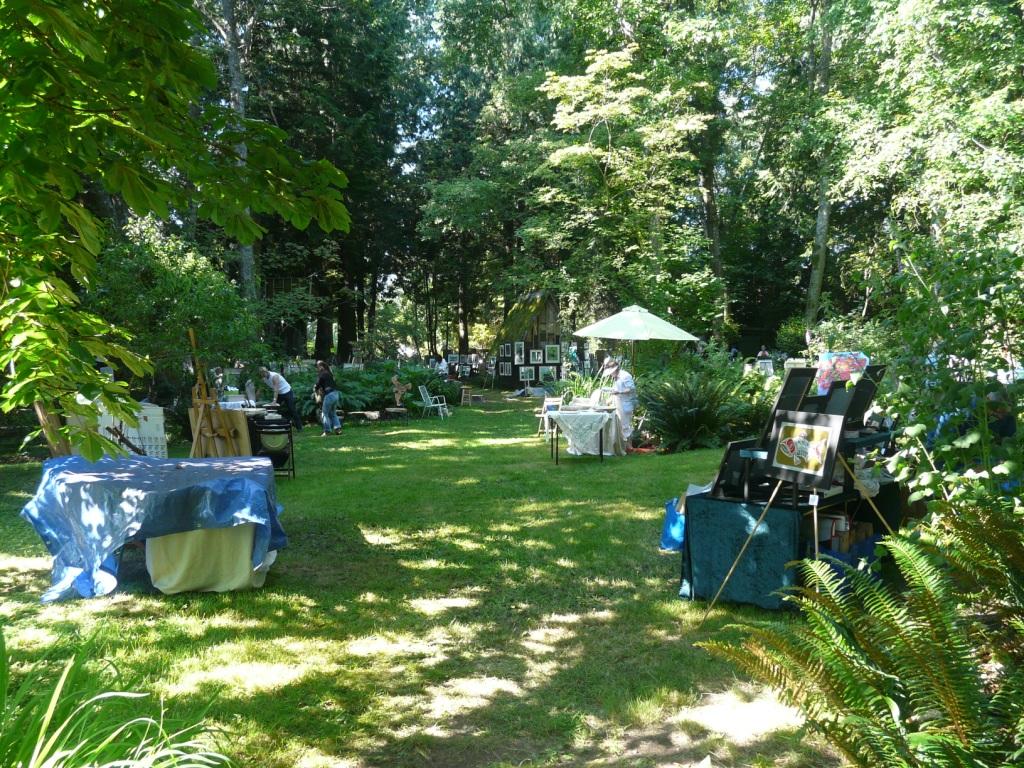
After the Wood Coop Gallery closed down, we took our wares door to door and came upon the Arnold Mikelson Mind and Matter Gallery. Mary Mikelson felt my work worthy and accepted us into her gallery. At the same time she encouraged us to participate in her annual Festival of the Arts in July. To make a long story short we altered our summer plans, burned the midnight oil to produce a body of work large enough to enter the festival and got our display organized. As you can see from the photos it was an outdoor affair in a wonderful setting.

It was generally a poor year, with all the regular attendees complaining about low sales volume. We only sold three pieces but there were many who sold nothing. We learned a lot about presentation, what people liked and that people in fact truly admired my work. One lady had to be convinced that “Venetian Trilogy” was not  glass and another lady asked “What am I looking at?”. She was confused because some looked like wood, other pieces looked like glass and she couldn’t believe that the coloured, highly figured wood hadn’t been hand painted. She meant it as a compliment and I was most grateful. We got some very good exposure, had direct offers to show my work in two other galleries and one to participate in the Arts at Darts festival as a result. Well worth the time, I would say. Although we didn’t sell much (times are tough) I would still encourage any artist to participate in an art festival (not a craft show) simply because of the exposure and how much you will learn.

As always, I encourage your comments and questions, so please refer to the tag line at the bottom of the article to post a comment.
 

Posted in General | Tagged , | 4 Comments

Nice note on another blog

Just got home from a motorcycle tour of western Canada. Lots of email to catch up on and one caught my attention right away. A gal named Patti stopped by our booth at the Mind and Matter Art Festival just before we left on our trip and praised my work very highly. She is an interior designer and uses a lot of art to decorate her homes. She posted a comment on her own blog http://rentfluff.wordpress.com/2010/07/14/mind and matter/. Thanks, Patti

As always, I encourage your comments and questions, so please refer to the tag line at the bottom of the article to post a comment.
Posted in General | Tagged , | 4 Comments

Welcome to Ed’s Woodturning

Welcome everyone. My Name is Ed Pretty. I have been a woodturner since the age of 9 when my father introduced me to the craft. I began to take the craft seriously at the age of 39 when a few of us formed the Fraser Valley Woodturners Guild in 1988. Since that time I have gained experience producing architectural woodturnings for builders and also enthusiastically pursued the artistic aspect of the craft. My work at this time is purely of an artisitic nature. My goal upon retirement from the fire service was to have my work displayed in a gallery and was successful on my first jury application to the Wood Coop Gallery on Granville Island. To everyone’s dismay, the Wood Coop had to close but my work has now been accepted in three other galleries; The Arnold Mikelson Mind and Matter Gallery in White Rock, BC, the Circle Craft Gallery in Vancouver, BC and The Little Cricket Gift Gallery in Fort Langley and Maple Ridge, BC. I presently belong to the Fraser Valley Guild as well as the Greater Vancouver Woodturners Guild (GVWG) and the American Association of Woodturners (AAW).

The purpose of the gallery page is to eliminate the need to carry a portfolio of my work with me wherever I go. Although my work is presented in the galleries, people often ask me in discussion for photos of my work. This site was orignally created to fulfill that purpose.

When we were putting the blog together  it occurred to me that the site could be so much more than a simple showcase.  I realized it was also an ideal opportunity to host a forum for woodturners. To that end I will be hosting discussions on just about any aspect of woodturning from wood selection to finishing as well as discussions about wood lathes, woodturning tools and other related tools.

If you are new to woodurning, I welcome your questions. In response to the need for instruction in basic woodturning skill, I established a Focus on Fundamentals program for one of the Guilds to which I belong. I have demonstrated these basic skills as well as other advanced skills to several groups, so am attuned to the needs of both basic and advanced turners.

I will be posting various articles and comments related to virtually any woodturning topic. I suspect that discussion relating to those posts will initiate questions and discussion that will provide ideal needs-based learning opportunities. If I know turners we can expect comment from all skill levels, providing a lot of knowledge in one place.

I hope that you will enjoy this blog. I am enjoying putting it together and know that as it progresses, I will enjoy it even more. Thanks for visiting!

As always, I encourage your comments and questions, so please refer to the tag line at the bottom of the article to post a comment.

Posted in Welcome | Tagged , , , , , , , | 6 Comments